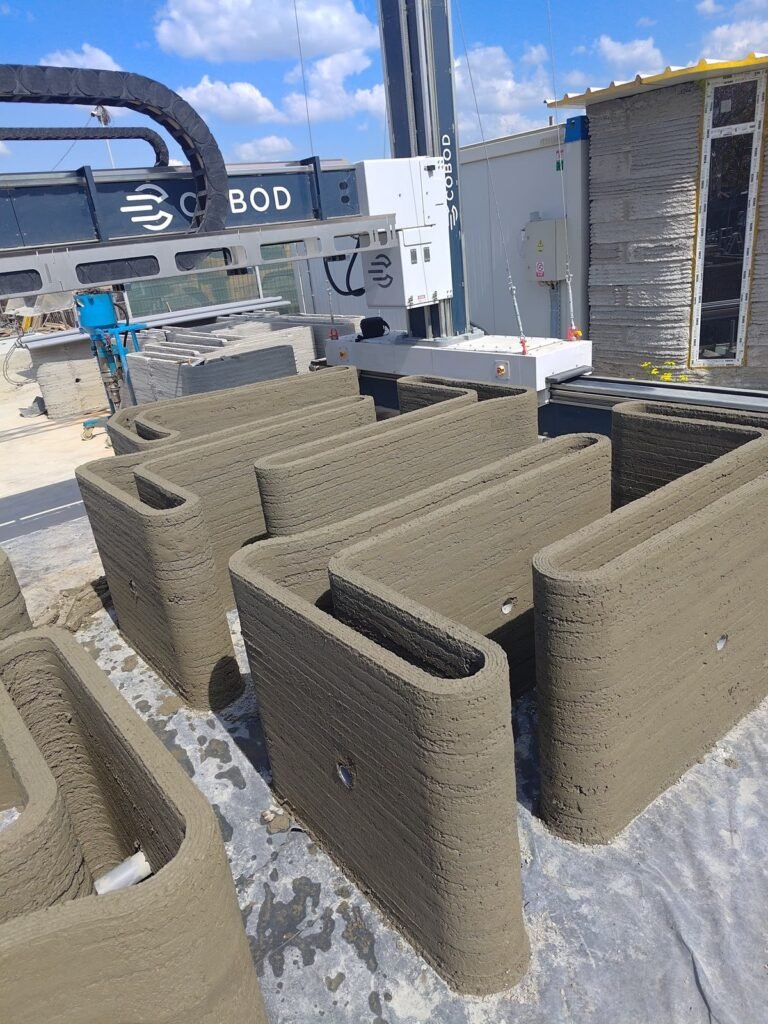
Concrete is one of the most widely used construction materials on the planet. Yet for decades, the way we’ve shaped it hasn’t fundamentally changed. 3D concrete printing is changing that ? not incrementally, but structurally.
What Is 3D Concrete Printing?
3D concrete printing (also called additive construction) is a process where a computer-controlled robotic arm extrudes a specially formulated concrete mix layer by layer, following a digital model. No formwork. No manual pouring. Just precise, programmable construction.
The technology has moved well beyond the laboratory. Industrial-scale systems like the COBOD BOD3 are now being deployed on active construction sites across Europe, producing structural elements, prefabricated components, and complex architectural forms that would be prohibitively expensive ? or simply impossible ? using conventional methods.
Why Now?
Three forces are converging to make 3D concrete printing a serious option for infrastructure and construction projects today:
- Labor shortages. Skilled construction labor is increasingly difficult to source in most markets. 3D printing reduces on-site crew requirements dramatically ? a single operator can oversee what would otherwise require a full formwork team.
- Material costs. Traditional formwork ? the wooden or metal molds used to shape poured concrete ? often accounts for 30?60% of the total cost of a concrete element. 3D printing eliminates that entirely.
- Design freedom. Curved walls, integrated channels, non-standard geometries ? forms that would require expensive custom molds become standard outputs when the printer follows a digital path.
Where Does It Work Best?
3D concrete printing isn’t a replacement for every construction method. It excels in specific contexts:
- Prefabricated infrastructure elements ? drainage channels, retaining wall sections, cable trench covers, utility housings. Repetitive geometry at volume.
- Complex structural components ? column bases, custom load-bearing elements, noise barriers with integrated form.
- Site-specific solutions ? elements designed for a precise location, produced on demand, delivered ready to install.
What It Doesn’t Replace
Flat slabs, standard beams, and simple poured foundations remain more economical with conventional methods. The value of 3D printing increases with geometric complexity, quantity, and the cost of skilled labor on a given project.
The Production Reality
Modern industrial printers like the COBOD BOD3 operate at print speeds that allow meaningful daily output ? not prototype-scale, but production-scale. Elements that take days to form, cure, and strip conventionally can be printed, structurally sound, within hours.
The process is also significantly leaner: material is deposited precisely where it’s needed, dramatically reducing waste compared to cut-and-fill formwork methods.
Working With a 3D Concrete Printing Partner
If you’re evaluating 3D concrete printing for a project, the key questions are straightforward: Does the geometry justify it? What’s the production volume? What are the local labor and material costs?
A capable printing partner can typically provide a cost comparison within days ? given a digital model or a technical specification of the element you need produced.
Get in touch to discuss your project requirements.