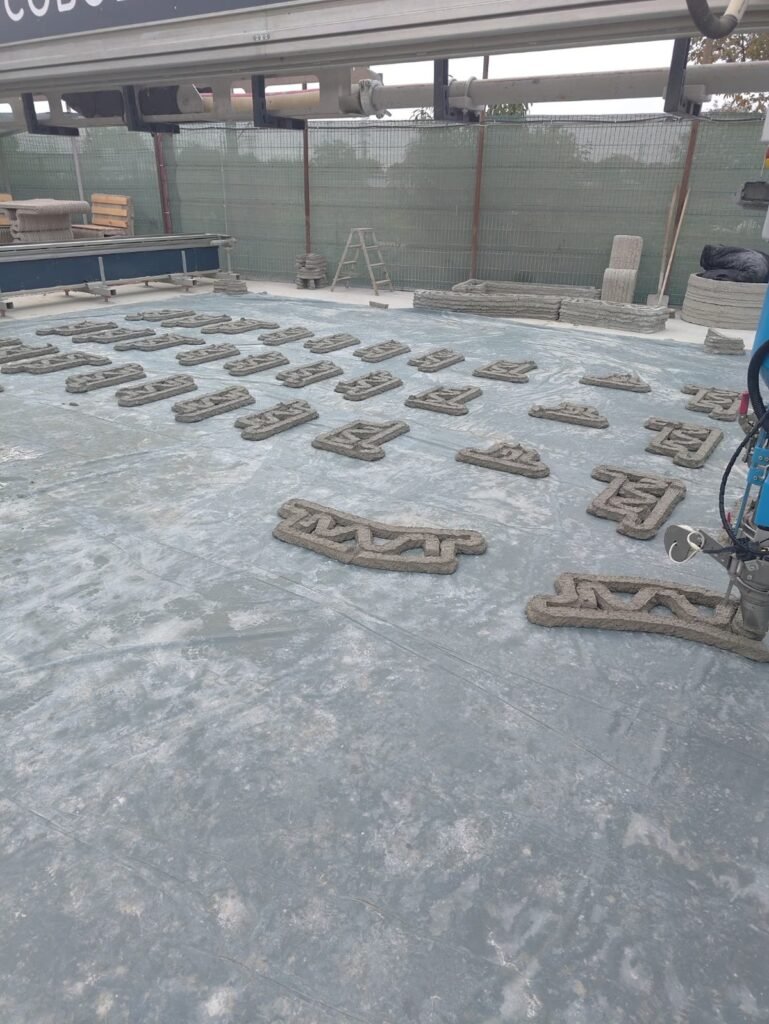
Formwork is efficient when a standard component is produced repeatedly from a well-designed, reusable mould. It becomes a larger cost and programme issue when geometry is unusual, reuse is limited, or each variation needs new tooling.
Cost percentages need the right context
ACI guidance notes that formwork can represent roughly 35 to 60 percent of cast-in-place concrete-work cost, depending on the structure and construction method. That range describes cast-in-place work. It should not be applied directly to conventionally mould-cast precast products with reusable tooling.
For precast production, the important inputs are mould design and fabrication, expected reuse, inserts or adjustable features, setup and stripping time, maintenance, storage, and the production quantity over which the tooling is amortised.
What 3D printing changes
Extrusion-based 3D concrete printing replaces the dedicated mould for the printed geometry with a digital model, a qualified toolpath, and automated deposition. This can make controlled variation practical without manufacturing a new mould for every version.
The rest of the production chain remains: engineering, material preparation, pumping, reinforcement, curing, inspection, handling, logistics, installation, and compliance. Some components also need supports, infill, embedded items, connections, surface treatment, or conventional concrete operations.
Complex geometry still has a cost
A curved or variable toolpath may avoid new tooling, but geometry still affects modelling, slicing, deposition time, acceleration, layer stability, support conditions, material quantity, reinforcement integration, dimensional control, and validation. Changes to load paths, interfaces, or reinforcement need engineering review and may require new trials or tests.
When printing deserves a comparison
- a dedicated mould would have little reuse;
- a family of components needs controlled geometric variation;
- conventional production requires substantial custom fabrication;
- the project can define its performance, reinforcement, tolerances, testing, and acceptance route;
- design readiness and qualification can be aligned with the delivery programme.
Standard high-volume components often favour established precast production. Custom channels, trench parts, transitions, and retaining components may merit a study, but their hydraulic, structural, geotechnical, durability, handling, and installation requirements can outweigh the forming cost.
Compare the same delivered scope
- geometry, quantity, design actions, exposure, service life, and interfaces;
- material performance, reinforcement, finish, tolerances, and acceptance criteria;
- tooling and expected reuse for the conventional option;
- engineering, slicing, trials, qualification, labour, batching, pumping, machine time, and energy;
- curing, testing, inspection, nonconformance, rework, and documentation;
- lifting, storage, transport, installation, joints, and site work.
The decision should use total compliant delivered cost and lead time, with assumptions and exclusions visible. Print time alone and mould cost alone are both incomplete comparisons.
Project screening
Layer By Layer Construction can screen a defined component once the technical requirements, quantity, and delivery scope are available. The first review identifies whether a detailed comparison is justified and what information is still needed.
Share a specification for an initial screening.
Sources
- ACI and ASCC, Contractor’s Guide to Quality Concrete Construction, formwork chapter: source and scope for the cast-in-place formwork cost range.
- ISO/ASTM 52939:2023: qualification principles for additive construction.
- NIST record for Buswell et al., 3D printing using concrete extrusion: process, material, geometry, and performance considerations.
- Surehali et al., anisotropy in additively manufactured concrete: evidence that layer orientation and interfaces can affect measured properties.
A cost comparison needs current project data, comparable scopes, and the applicable product and acceptance requirements.