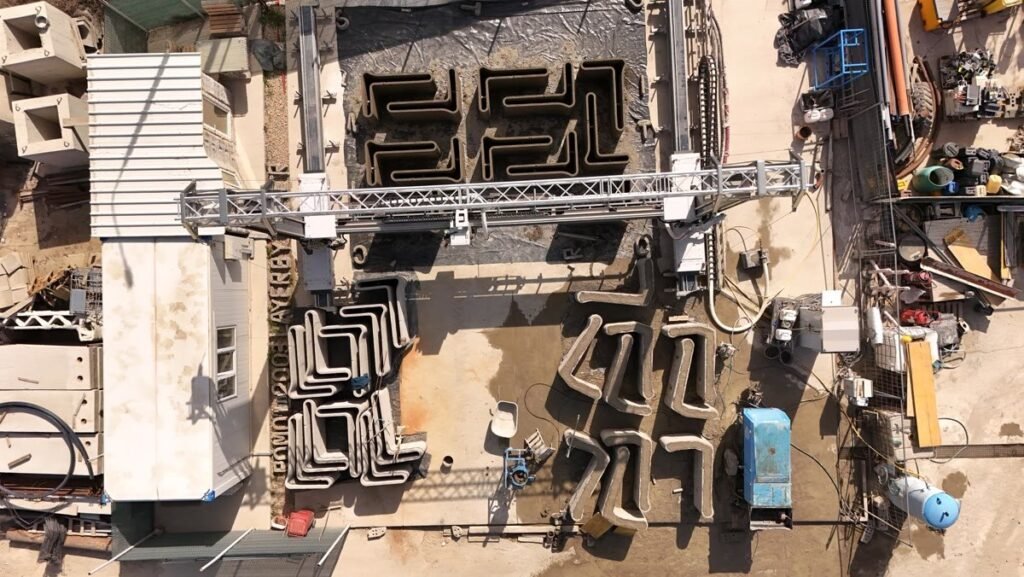
Industrial 3D concrete printing requires more than a large robot. It combines a validated digital model, a controlled material-delivery system, a defined process window, structural design and project-specific quality control.
System architecture
The BOD3 is a rail-mounted mobile gantry intended for high-volume, low-rise construction. Its extendable ground-track system allows the printer to move between successive structures, while the printhead follows digitally generated paths. The exact working envelope and tolerances depend on the delivered configuration and the project quality plan.
Material delivery and printability
Printable concrete must satisfy several competing requirements: it must move reliably through the delivery system, extrude without blockage, retain its deposited geometry and develop sufficient early-age strength to support subsequent layers. These properties depend on the material, equipment, geometry and environmental conditions.
CEMEX describes D.fab as an admixture family that adapts conventional concrete for pumping and printing. It is not a mandatory proprietary mortar, and the complete mix still requires project-specific validation.
Digital model and print sequence
Print paths are generated from a digital model. Layer dimensions are not universally fixed: they are selected according to the concrete, nozzle, travel speed, geometry and validated process window. Production is executed in planned sequences rather than assumed to run without interruption; reinforcement, checks and construction sequencing may require controlled pauses.
Interlayer performance depends on the complete material-process combination. Experimental research shows that longer intervals and surface drying can reduce bond strength, so acceptable intervals must be established through testing and quality control.
What the system can produce
BOD3 can deposit wall and component geometries, including curved forms and integrated voids or channels. It may be considered for low-rise buildings, prefabricated elements, infrastructure components and architectural forms where additive production offers a practical advantage.
Printer capability does not by itself establish structural approval. Whether an element is load-bearing depends on structural design, reinforcement, material characterisation, testing, applicable codes and project approval.
Reinforcement
Reinforcement must be designed for each structural application. Available approaches include reinforcement placed before, during or after printing, reinforced infill and fibre-reinforced mixes. Fibres can improve crack control and mechanical performance, but they do not generally replace conventional reinforcement. Any partial or complete replacement requires structural calculation, testing and approval for the specific component.
Assessing project fit
A useful assessment starts with geometry, volume, material, reinforcement, exposure, tolerances, finish, handling and installation. Only then can production capacity, cost and schedule be compared with a conventional method on the same scope of work.
Contact Layer By Layer Construction to discuss a specific component or project.
Sources and technical reading
- COBOD: official BOD3 introduction
- COBOD: 3D construction printer range
- COBOD: material approach for construction printing
- CEMEX: D.fab concrete admixture technology
- TU Eindhoven: review of extrusion-based additive manufacturing with cement-based materials
- TU Eindhoven: process parameters and interlayer adhesion
- Peer-reviewed review of reinforcement strategies for 3D concrete printing
- ISO/ASTM 52939:2023: qualification principles for structural and infrastructure elements