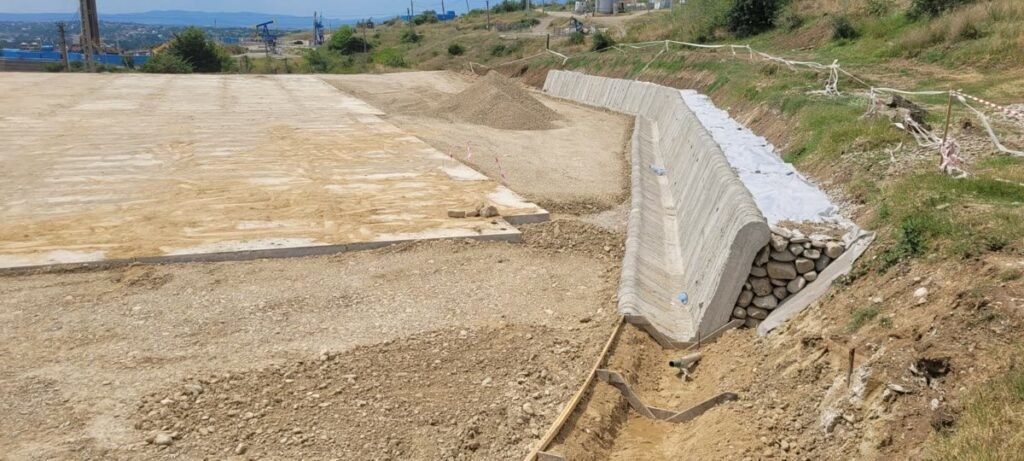
Not every concrete element is a good fit for 3D printing. Flat slabs and standard beams are typically more economical with conventional methods. But certain infrastructure components sit in a different category ? and drainage channels, retaining wall sections, and cable trench covers are among the clearest examples.
The Common Thread
What makes these elements well-suited to 3D printing?
- Defined cross-section, variable length. A drainage channel has a consistent profile that extends over distance. This is exactly what a printing path is optimized for: repeated geometry executed efficiently.
- No structural complexity that requires traditional reinforcement placement. Many channel and trench elements can be designed to work without rebar, or with minimal reinforcement, simplifying the print process.
- High formwork cost relative to element value. Custom channels and shaped retaining elements require purpose-made molds. The mold cost often represents a disproportionate share of element cost, particularly for non-standard profiles.
- Site-specific requirements. Infrastructure projects frequently require elements tailored to specific gradients, widths, or connection details. 3D printing accommodates this without penalty.
How the Production Process Works
For a typical infrastructure element order:
- Technical specification or drawing is provided by the client or design engineer
- The element is modeled or adapted for print path generation
- Print runs are scheduled based on volume requirements
- Elements are cured on-site or in a covered production area
- Delivery is coordinated with the installation schedule
Lead times depend on volume, but the absence of custom formwork fabrication typically compresses the production timeline compared to conventional prefabrication.
Quality and Compliance
3D printed concrete elements are produced from engineered mix designs developed for printability and structural performance. Material testing is standard practice. For infrastructure applications ? where elements may be subject to public procurement requirements ? documentation of material properties and production process is an integral part of the delivery package.