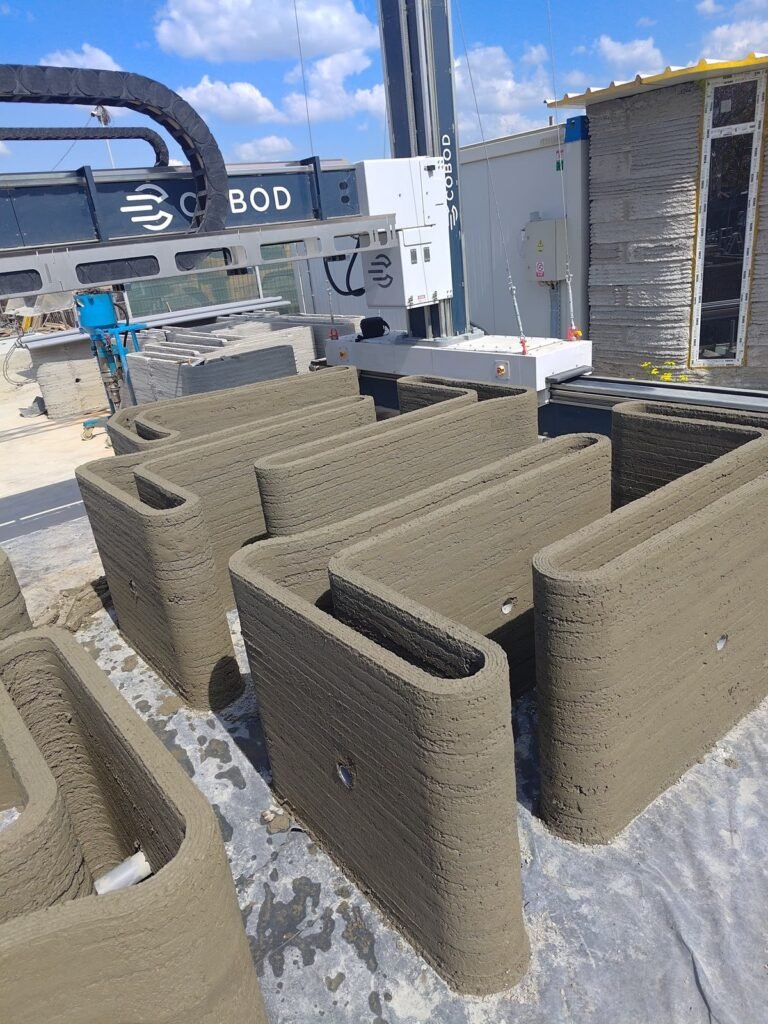
Extrusion-based 3D concrete printing is most useful when a project combines non-standard geometry, controlled variation, and production volumes that do not justify dedicated tooling. Standard components with mature moulds and supply chains may remain better suited to conventional precast or cast-in-place construction.
How the process works
A computer-controlled gantry or robotic system deposits a printable cementitious material layer by layer from a digital model. The COBOD BOD3 used by Layer By Layer Construction is a rail-mounted mobile gantry, not a robotic arm. Its movement follows a prepared toolpath while batching, pumping, deposition, and process monitoring operate as one production system.
Printing can remove the dedicated mould for the deposited geometry. Structural design, reinforcement, supports, embedded items, connections, curing, surface treatment, lifting, inspection, transport, and installation may still be part of the scope.
Printing is one stage of production
- Design and qualification: define geometry, material, toolpath, interfaces, reinforcement, and acceptance criteria.
- Deposition: maintain pumpability, extrusion quality, and early stability as the layers are placed.
- Curing: apply the specified regime and allow the material to develop the properties used in design.
- Handling and delivery: release lifting, storage, transport, and installation after the handling criteria are met.
- Acceptance: check dimensions, material properties, reinforcement or embedded items, visible condition, and the required durability or functional tests.
A completed print is therefore not automatically ready to load, handle, or place in service.
Applications worth screening
Useful candidates include custom channels, transitions, utility components, architectural features, and other parts that would need new or heavily modified tooling. Repeated profiles with controlled variations can also be suitable when the toolpath, joints, handling, reinforcement, and end use can be qualified.
The application determines the engineering evidence. Drainage components need hydraulic and, where relevant, traffic-load and watertightness checks. Retaining components need structural and geotechnical verification. Reinforcement follows the design actions, cracking and durability criteria, handling loads, connections, and applicable standards.
Where conventional methods remain strong
Standard beams, slabs, blocks, and repeat products may already have efficient moulds, established reinforcement workflows, recognised product standards, and optimised logistics. Conventional precast can be the lower-risk or lower-cost route in these cases. Cast-in-place construction may also suit projects where continuity, site conditions, access, or interfaces make prefabrication impractical.
What drives cost
3D printing changes the cost structure rather than guaranteeing a saving. ACI guidance notes that formwork can account for roughly 35 to 60 percent of cast-in-place concrete-work cost, depending on the structure and method. That figure should not be transferred to standard precast products made with reusable moulds.
A useful project comparison includes geometry, quantity, material, reinforcement, finish, tolerances, trials, engineering and slicing, batching and pumping, labour, machine time, curing, inspection, testing, rework, lifting, transport, installation, interfaces, and compliance documentation. The conventional option should include tooling cost and expected reuse. The decision metric is total compliant delivered cost for the same functional specification.
Environmental performance depends on the design
Selective material placement and the avoidance of dedicated moulds can reduce waste in suitable applications. The overall result also depends on binder and admixture content, reinforcement, geometry, energy, curing, transport, service life, and end-of-life assumptions. A project inventory or life-cycle assessment is more useful than a general sustainability percentage.
What to send for an initial review
Provide the geometry, quantity, design actions, exposure, reinforcement concept, finish, tolerances, test requirements, delivery location, and installation constraints. Layer By Layer Construction can then assess whether a technical and commercial comparison is appropriate and identify the qualification work required.
Contact us for an initial project screening.
Sources
- COBOD, 3D construction printers: manufacturer information on the BOD3 platform and operating workflow.
- ISO/ASTM 52939:2023: qualification principles for additive construction and structural or infrastructure elements.
- NIST record for Buswell et al., 3D printing using concrete extrusion: research on the relationship among material, process, geometry, and performance.
- ACI and ASCC, Contractor’s Guide to Quality Concrete Construction, formwork chapter: context for the cited cast-in-place formwork cost range.
- Fonseca et al., sustainability and circularity in 3D construction printing: review of project- and mix-dependent environmental effects.
The current Romanian and European standards, national provisions, product route, and project acceptance criteria should be confirmed for each application.