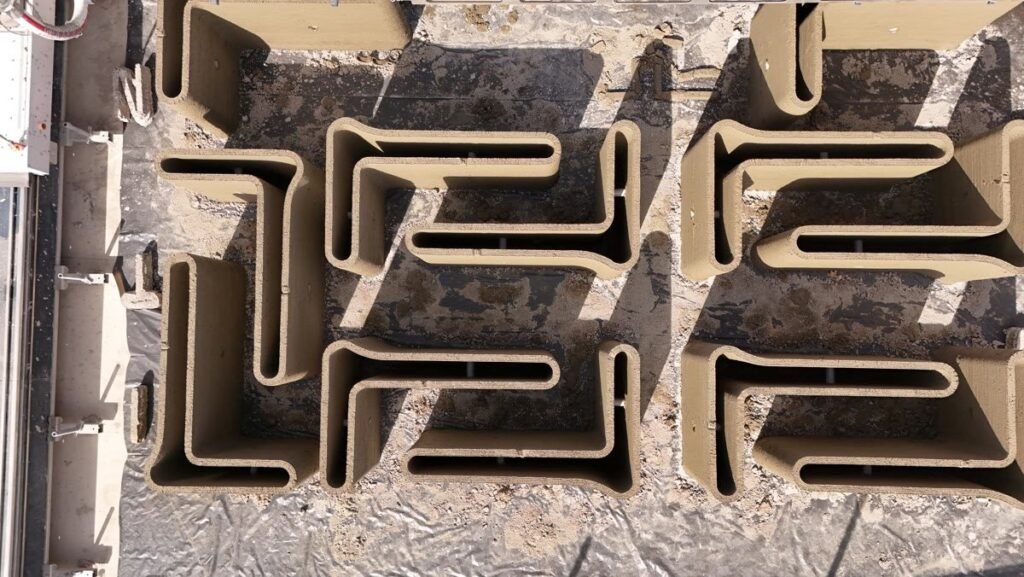
3D-printed concrete components and conventional precast products can both be manufactured away from their final installation position. The useful comparison is therefore between 3D-printed prefabrication and conventionally mould-cast precast concrete.
The right choice depends on the component, not the novelty of the process. Both options should be compared against the same geometry, performance, reinforcement, finish, tolerances, testing, quantity, delivery scope, and installation conditions.
Geometry and repetition usually shape the first decision
| Project condition | What it often suggests |
|---|---|
| Standard geometry with high repetition | Reusable moulds and established precast routines may offer the simplest route. |
| Non-standard geometry or limited reuse | 3D printing may avoid a dedicated mould that would be used only a few times. |
| Controlled variation across a family of parts | A digital workflow can change length, profile, openings, or transitions without rebuilding the full tooling set. |
| Mature product standard and supply chain | Conventional precast may reduce approval, procurement, and logistics risk. |
| Tooling-sensitive programme | Printing may shorten the tooling stage once design and qualification are complete. |
A model can be revised faster than a steel mould, but a geometric change may still affect the load path, reinforcement, interfaces, lifting, toolpath, deposition stability, material demand, testing, and approval. Digital variation works best when revision control links the accepted design to the production and inspection records.
Qualification and release matter as much as forming
Conventional precast families often use established product standards, reinforcement methods, factory production control, and declared tolerances. ISO/ASTM 52939 provides qualification principles for additive construction, but the component still needs the structural design, product route, national provisions, and project acceptance criteria that apply to its use.
Printing ends at deposition; production does not. Curing, handling strength, dimensions, material properties, reinforcement or embedded items, durability, function, and documentation must be checked before a component is released.
Some product families need extra engineering inputs
Drainage components require hydraulic capacity, load class where relevant, joints, watertightness, exposure, maintenance, and installation details. Retaining-wall components require structural and geotechnical verification, including earth and groundwater pressures, surcharge, sliding, overturning, bearing, overall stability, cracking, drainage, lifting, and connections. Printing can create the shape, but it does not replace these checks.
Use total compliant delivered cost
A commercial comparison should include:
- engineering, modelling, and approval work;
- tooling, inserts, maintenance, storage, and expected reuse;
- material, reinforcement, production, and curing;
- trials, specimens, inspection, testing, and documentation;
- nonconformance, rework, lifting, storage, transport, and installation;
- interfaces, joints, site work, capacity constraints, and programme dependencies.
The relevant result is total compliant delivered cost and lead time for the same functional specification. Print time compared with mould fabrication alone is not a complete business case.
A hybrid route can be sensible
A project may use conventional precast for standard repeat parts and 3D-printed prefabrication for custom transitions or low-reuse geometries. The split should follow the technical scope, interfaces, quantities, approval routes, and installation sequence rather than a preference for one production method.
Layer By Layer Construction can screen a defined component and delivery scope, then identify whether printing, conventional production, or a hybrid study deserves further analysis.
Send a component specification for project-based screening.
Sources
- ISO/ASTM 52939:2023: qualification principles for additive construction.
- NIST record for Buswell et al., 3D printing using concrete extrusion: process and performance research needs.
- The Concrete Centre, European standards for precast concrete: overview of common and product-specific precast standards.
- European Commission JRC, Eurocode 2: concrete structural design framework.
- Surehali et al., anisotropy in additively manufactured concrete: evidence on directional and interlayer behaviour.
Current standards, national provisions, product routes, and acceptance criteria should be confirmed for the component and place of use.