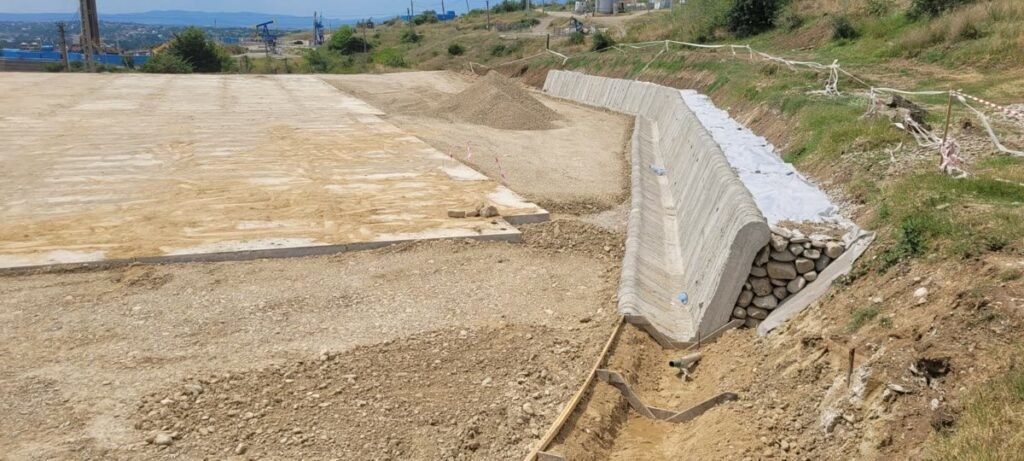
3D concrete printing is no longer science fiction. In Romania, Layer by Layer Construction already operates one of the first industrial concrete printers in Eastern Europe — the COBOD BOD3 — producing real structural elements for infrastructure projects.
If you are a contractor, architect, or project manager and want to understand what this technology can do for you, you have come to the right place.
What is 3D Concrete Printing?
3D concrete printing (also known as concrete additive manufacturing) is a process in which an extrusion head deposits successive layers of specially formulated mortar, following a precise digital model.
The result: construction elements with complex geometries, produced quickly, with reduced material consumption and without traditional wooden formwork.
Our printer: COBOD BOD3 — Danish industrial equipment with a working area of 12m × 12m × 9m. One of the largest 3D concrete printers in the region.
5 Real Advantages Over Traditional Construction
1. Production Speed
A prefabricated element that classically requires 2–3 days of forming, pouring, and stripping can be produced in a few hours on the printer. Increased productivity = shorter deadlines.
2. Complex Shapes at No Extra Cost
In traditional construction, a curved or non-standard geometry means expensive formwork and long execution time. In 3D printing, shape complexity does not increase cost — the digital file is the only “formwork” needed.
3. Reduced Material Waste
The printer deposits exactly the amount of concrete needed, with no surplus. Compared to traditional casting, material reduction can reach 30–40% on certain elements.
4. Perfect Repeatability
Once the file is set, every element comes out identical to the previous one. Essential for series production — reinforcement trenches, pipes, drainage channels, drainage elements.
5. Complete Digital Documentation
Each element is based on a .cobod file with exact parameters. Full traceability for quality and certification requirements in public projects.
What Elements Do We Currently Produce?
- Reinforcement trenches for oil and gas infrastructure
- Drainage and sewage elements (channels, manholes, pipes 60–100 cm)
- Urban furniture (benches, tables in printed concrete)
- Concrete Lego elements (reusable modular blocks)
- Custom architectural elements (on request)
We have available capacity and are open to new orders.
When Does 3D Printing Make More Sense Than Traditional Methods?
3D concrete printing does not replace traditional construction in all situations. It makes sense especially when:
- You produce repetitive elements in series (tens or hundreds of identical pieces)
- You need complex geometries (curves, organic shapes, special joints)
- You want to reduce dependence on skilled labor
- The project requires short deadlines and delivery flexibility
How Much Does It Cost?
The price varies depending on element complexity, concrete volume, and quantity ordered. In series production, the price per unit drops significantly compared to individual production.
Contact us for a personalized quote. We respond within 24 business hours.
3D Printing in Public Projects
To use 3D printed concrete elements in state-funded public works, a Technical Approval is required. Layer by Layer Construction is in the process of obtaining this certification, which will open access to large-scale infrastructure projects.
If you are a contractor or consortium bidding for public projects and want to explore partnership, contact us now — the joint qualification process can start at any time.
Contact Us
Layer by Layer Construction
Buzău, Romania
layer.by.layer.construction@gmail.com
3drim.com