Not every concrete component should be 3D printed. For simple, fully standardized elements produced in very large volumes, conventional precast concrete often remains the right solution. 3D printed concrete becomes useful when geometry, project-specific adaptation and the cost of formwork matter more than repeating a catalogue shape.
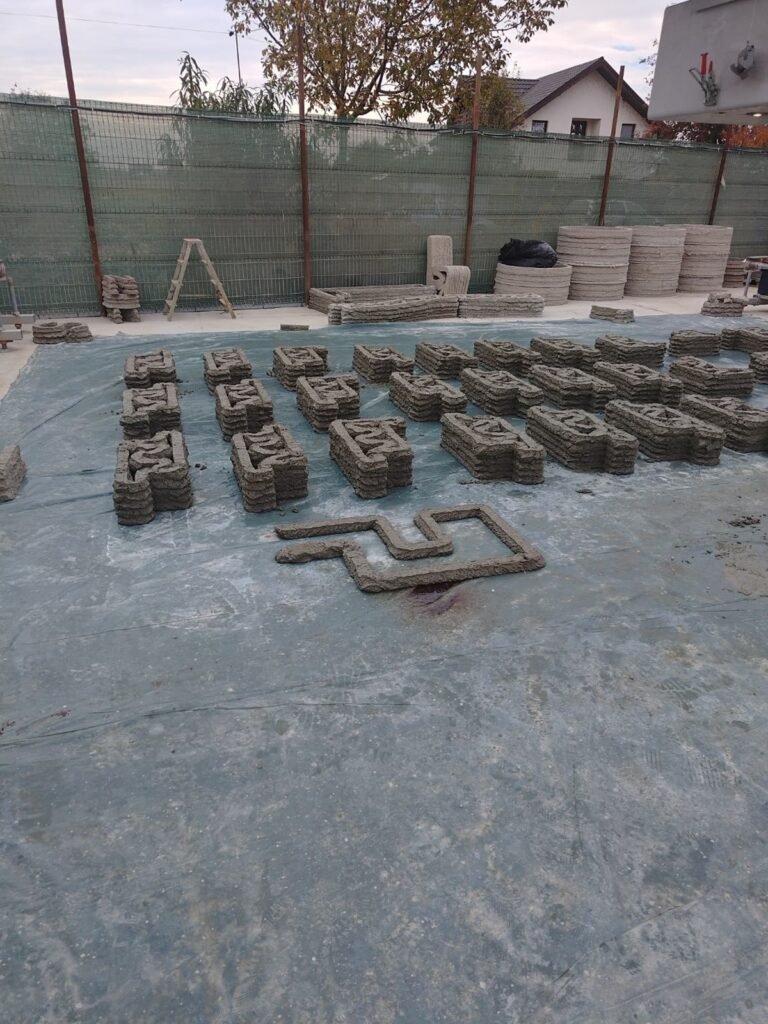
Layer By Layer Construction operates an industrial COBOD BOD3 system in Buzău, Romania. The company uses it for infrastructure-related precast components such as reinforced trenches, drainage channels, gutters, custom drainage pieces and concrete elements that would be difficult or expensive to produce with dedicated formwork.
Why infrastructure is a strong use case for 3D printed concrete
Infrastructure includes many components that look simple at first, but become complex in execution: variable profiles, slopes, transitions, unusual cross-sections, different lengths or adaptations to real site conditions. In conventional production, every deviation from the standard can mean new formwork, manual adjustments, additional time and higher risk of error.
In 3D concrete printing, the shape comes from the digital model. Once the component is properly defined, the system deposits material layer by layer along a programmed path. This allows repeatable production for similar elements while still permitting controlled variations without building new formwork for every case.
Components that make sense to produce this way
- Reinforced trenches — linear components for drainage, side protection or areas where a consistent profile must be maintained over length.
- Channels and gutters — rectangular, trapezoidal or project-specific sections for stormwater and industrial drainage.
- Drainage components — connection pieces, transitions, partial elements and shapes adapted to site constraints.
- Special-geometry components — textured surfaces, rounded edges, curved forms or elements that would require disproportionately expensive formwork.
LBL’s experience comes from actual production, not only from demonstrations. In the context of works supplied for OMV Petrom through Romoil, more than 300 prefabricated elements have been produced, with a focus on repeatability, handling and dimensional control.
Where 3D printing outperforms conventional formwork
| Criterion | Conventional precast | 3D printed concrete |
|---|---|---|
| Shape | Optimized for moulds and catalogues | Digitally defined and project-specific |
| Formwork | Important fixed cost, especially for special geometry | Removed for the printed geometry |
| Small series | Often uneconomical | More suitable when elements vary |
| Lead time | Depends on moulds, stock and suppliers | Depends on model, material and production planning |
| Dimensional control | Strong for standard forms | Strong for custom forms, verified per project |
The correct process: from digital model to verified element
A 3D printed element does not start with the printer. It starts with design. The geometry must be cleaned, the section must be checked and the print path must be planned so the component can be produced, handled and installed correctly.
- Digital model — the component is defined as a volume, not only as a drawing.
- Production review — wall thickness, radii, edges, fragile zones and lifting/handling logic are assessed.
- Slicing and print path — the model is converted into layers and deposition paths.
- Controlled printing — material, speed and deposition parameters are monitored during production.
- Post-production verification — the elements are measured, handled and assessed before delivery.
Real limitations: when 3D printing is not the answer
The technology is not a universal replacement for precast production. Flat slabs, simple blocks, standard beams or components already produced efficiently at scale do not automatically become better because they are printed. In those cases, conventional methods may be faster and cheaper.
3D printing makes sense when it removes difficult formwork, reduces on-site adjustments or enables geometry that conventional methods make too expensive. The real advantage is not spectacle; it is control over shape.
What quality means in 3D printed concrete
Quality does not come from the printer alone. It depends on the material, mix design, working conditions, equipment calibration and the way the element is designed. For LBL components, the goal is repeatable production, project-level dimensional control and practical verification before delivery.
COBOD BOD3 is an industrial system, not a lab demonstrator. Its advantage is the ability to work with large volumes, long paths and controlled geometries in a workflow compatible with precast element production.
Conclusion
3D printed concrete prefabrication is not about making every component look futuristic. It is about producing concrete elements more efficiently when conventional methods require expensive formwork, many adjustments or geometry compromises. For trenches, channels, gutters and infrastructure components with specific shapes, 3D printed concrete can be a very practical production tool.